I don’t often reblog a post from so when I do you know the person said something I think is important. What Denise, from Hearing Elmo talks about is important. We have to stop apologizing for our “normal”. Please check out her site for many more important topics, Denise is an amazing advocate.
The other day my iPhone died before I was getting ready for bed. I was a little shocked, because I rarely have it just “die” on me. The new ones have batteries that last much longer – even if you are a frequent user of the device like I am. I stood there with dead […]
Hello. My name is Wendy. I just turned 53 years old and I have chronic illnesses, including Meniere’s Disease. Unless something amazing happens, they are not going to go away. Sometimes I feel I need to make this statement before anyone speaks to me.
Recently I was asked a few things about my health. This was not by people who see me often, or have much knowledge about my illnesses. This is how I handled a few of the questions, some of it was good, some not so good.
Have you tried yoga? It can really help your balance. I used to do yoga regularly until the Meniere’s Disease got so bad and I ended up on my face during a class. It can only help your balance if you have some to start with! After having a disease ruin your balance system, yoga isn’t possible. (ok, this may have been a bit harsh, and some people with Meniere’s may get some help from yoga, I don’t know. However, anyone as advanced as I am, who has been through Vestibular Therapy and still has balance issues all the time, cannot do yoga. And if you have had a disease the compromises your balance for as long as I have, do you not think I would have heard about YOGA by now?)
I heard about these positions you can get in that will make vertigo go away. Why can’t you just do that? There are maneuvers you can do to help certain types of vertigo. However, there are numerous causes for vertigo and what causes mine can not be helped by those maneuvers. (do people think my doctors would just let me suffer this much if it was so simple to “cure” my vertigo?)
Do you think this could have been caused by all the drugs back when you were younger? Okay, this one caught me off guard. I thought, what the heck is she talking about? I may have experimented a little when I was younger, but she wouldn’t have known that. I must have looked shocked and said,“nooooo?”She then explained, “All those psychiatric drugs they put you on.”I was shocked. How could someone think that the treatment I received for my mental illness caused me to get chronically ill? I’m sure I looked shocked when I answered,“No.”“Well I was thinking….” I stopped and said,“I know many people with Meniere’s disease and really we have nothing in common except some of us have relatives with the same disease. They have no idea what causes this.”“That’s good to hear, I’ve been so worried about it.” “Well there is no need to worry about that. The medication I’ve taken for my Bipolar did not cause me to get ill.” AHHH!
This last question has continued to plague me. Is this one of the reasons people do not seek help for their mental illness, they are afraid of what side effects the medications may cause?
I have Bipolar I disorder. I take medication for it. I also try to keep a good sleep schedule, eat well, keep my stress controlled, and see a therapist…there is a lot more to taking care of yourself when you have a mental illness than just taking your medication.
I have never been afraid of taking my medication. Each time my medication is changed my doctor and I talk about it. We discuss exactly what it is supposed to do, any side effects, if it will react with any other medications I’m on at the time, and if the side effects are worth it. I don’t just take a medication not knowing what it will do to me. No one should do that. If your doctor does not automatically discuss these things with you make sure you ask BEFORE you fill your prescription and start taking a medication you are not familiar with. I also advise you to read the information the pharmacist gives you about your new medication just in case your doctor forgot something. It happens, doctors are human too.
I have decided to take a medication even though I knew there was a chance it could cause damage to my thyroid. It did. I now have to be on medication for hypothyroidism. Am I upset that the medication caused this side effect. No. I went into this with my eyes wide open. At the time there were very few medications to treat Bipolar I and I decided the pay off from the drug was worth the side effect that it may cause. I’m still happy I decided to take that medication and have those years as a stable person. Truthfully, I would take it again today if that was the only medication that would keep me stable.
I would hate to think that people would not seek out treatment for any illness because they are afraid of the side effects of the medication they might be put on. Become informed. Know what the medications will do. Know how it will help you and the side effects it may cause, you decide if it is the right medication for you.
Many of you may be thinking that there are times that a certain side effect is unknown. You are right. There are many stories of someone who took a medication and had a severe reaction. There are stories of people taking a medication and years later they find out that it hurt them in ways they never knew it could. These stories are not typical. We simply can’t live in fear and not be treated because of the “what ifs”.
I can tell you, if I hadn’t been treated for my Bipolar for all these years, my life would be totally different, and not in a good way. I can almost tell you for certainty that I would not be alive to write this post. I will never regret taking the medications that helped save my life.
Yep, I’ve started a Facebook page, and I’d love it if you followed me there. It’s a very easy way to get in touch with me. All my post will be listed there and I do post little things there that I don’t post here, so jump on over there and Like my page.
“Whether we are basically healthy at the moment or have a terminal illness, none of us knows how long we have to live. Life only unfolds in moments. The healing power of mindfulness lies in living each of those moments as fully as we can, accepting it as it is as we open to what comes next—in the next moment of now.”
― Jon Kabat-Zinn, Full Catastrophe Living (Revised Edition): Using the Wisdom of Your Body and Mind to Face Stress, Pain, and Illness
I got my first cochlear implant (CI) in July of 2011, and my second in September of 2013. When I was going through that time I wrote some about it but I’ve never talked about what it’s like to live with my cochlear implants (CIs). A friend of mine asked me a few questions about it recently. I’m here today to answer some of those questions.
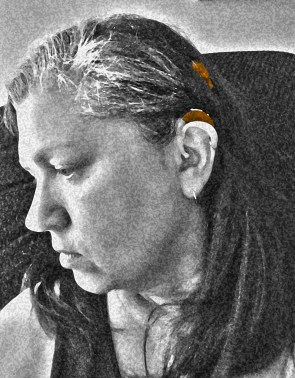
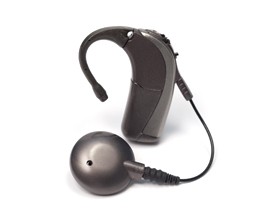
What exactly is a Cochlear Implant? – To put it simply, a Cochlear Implant is an electronic device that can help provide a sense of sound to someone who is deaf or severely hard of hearing. Let me see if I can explain this in my own words. There is a part that is on the outside of the head that consist of a microphone a processor and a transmitter. There is part that is on the inside that is the stimulator and the electrode array. Sound comes into the microphone and goes through the speech processor to the transmitter (the microphone and processor are the parts around the ear, the transmitter is the part that is on the outside of the head – it is held on by a magnet connecting it to the receiver/stimulator). The stimulator is in my head, between the skin and the skull. When the sound comes in to the stimulator it is then sent to the electrode array it then send impulses to the auditory nerves. For a better explanation please go here. (you can see the microphone, processor and transmitter on me in the photo at the top of the post – yes mine are orange -, and in the second photo below)
This is a photo of the receiver/stimulator and the array. The array is the wire it is what goes in the cochlea of the ear and sends impulses to the auditory nerves. The stimulator is right on the inside of my head. The transmitter connects to the stimulator by a magnet.This is a photo of a microphone, processor, and transmitter. You can readily see the microphone that hooks around the ear but there is one at the top you can’t really see. Many processors have microphones that are not readily seen.
Why did you get cochlear implants? – I lost my hearing due to Meniere’s Disease. My hearing loss happened fairly quickly. I was diagnosed bilateral in November of 2009. In 2010 I got hearing aids, within 3 months of having my hearing aids I couldn’t understand anything out of my left ear. That sent me on the tract to getting my first CI. (July 2011) By the time I received my first CI, the hearing in my right ear deteriorated to the point that my hearing aid no longer worked. It took a little while, but I soon got my second CI.(September 2013) Why did I get cochlear implants? because that was the only way I would be able to “hear” anything.
How does a cochlear implant work? – I’m going to quote this straight from the National Institute of Deafness and other Communication Disorders site. “A cochlear implant is very different from a hearing aid. Hearing aids amplify sounds so they may be detected by damaged ears. Cochlear implants bypass damaged portions of the ear and directly stimulate the auditory nerve. Signals generated by the implant are sent by way of the auditory nerve to the brain, which recognizes the signals as sound.”
Do you hear the same with a cochlear implant as a you do with normal hearing? – No. Some people can understand words and sounds immediately, other people can only hear clicks and whistles. It is a completely different way of hearing and your brain has to be retrained. When I was first activated I could understand a lot of words from the start, but everyone sounded like they had been sucking on helium. A lot of Donald Duck and Mickey Mouse voices were around. Soon my brain started to remember what certain sounds sound like and I started hearing things the way I used to, for the most part. When I hear something I’ve never heard before things can sound very odd. Sometimes when I meet a new person their voice will get that cartoon sound until I get used to them. The longer you use your CIs the better you hear with them, so 10 years from now I should hear better than I do now.
Do you now hear like everyone else? or is it odd? What is your hearing like now? – This is the big question isn’t it? What is my hearing like now? First I’ll tell you about challenges I have that a lot of people with CIs have, then I’ll tell you about my personal challenges.
I often can’t hear when someone speaks behind me. If there is noise in the room I have a very hard time hearing. (the newer CI’s are better for this, even though I have a newer CI I still have a hard time) In groups it is very hard to keep up with what everyone is saying. I am much better at conversing one on one. I find I it is much easier for me if the person is facing me so I can read their lips while they are talking to me. Between the two of those I do pretty well, but put me in a crowded room, and I’m lost. Heck, put me in a room with more than one person and I can get pretty lost.
I think I might be able to hear better if I had more practice, I’m not sure. Most of the time I only talk with Stuart. I talk to my doctors. I talk with our roommate, but I have a very hard time understanding him. His voice is deep and I simply cannot understand most of what he says. It makes things difficult, and sad. But for the most part I don’t see anyone else. Since we moved I haven’t met many new people, it’s hard to get used to groups and hearing other people when I don’t have the opportunity. However, it’s also really hard to put myself out there in those situations because I get so lost and confused. It does make meeting new people even more challenging.
Unlike most people with cochlear implants my hearing fluctuates. Some people with Meniere’s who get CI’s end up still having fluctuating hearing. Normally this happens when we have vertigo, our hearing will change and we need to get our CI’s adjusted. My hearing doesn’t fluctuate just when I have a vertigo attack it happens every day.
Let me tell you what an average day for me is like. I’ll get up and put on my cochlear implants, at first it takes me a little bit to get used to suddenly hearing sound. Everything sounds a bit loud. Then things will normally calm down and my hearing is stable for a few hours, but every evening my hearing will change. It’s hard to explain what it sounds like, it gets hollow sounding and can sound way too loud. I’m always telling Stuart to please be quieter. Sometimes my hearing will change throughout the day. I will often say, “I’m having a bad hearing day.” I’m thrilled when I can say I’m having a good hearing day.
When I take my CI’s off the world changes. Suddenly the only thing I can hear is my tinnitus. (When I have my CI’s on the sound of the outside world helps me to not notice my tinnitus as much.)
I don’t know sign language. I am working on learning some, but I haven’t been able to take a class. At times Stuart and I can only communicate by me reading his lips and the little bit of sign language we know.
What is a challenge you wouldn’t normally think about? – This one is easy, having the headpiece suddenly fly off because I got too close to something metal. I have a bracelet that I wear sometimes and if I put my arm up around my head the CI headpiece (the transmitter) will jump off and stick to it. It’s kind of funny, kind of annoying. Other times when I want to lie down the headpiece won’t stay on. This is annoying, especially when I’m sick. I deal with vertigo better when I can hear what is going on around me since I can’t focus on anything, but during an attack I need to lie down, this often knocks my CI off and I can’t hear anything out of one ear.
Does it hurt? – Well the surgery hurt, but it wasn’t so bad. It is actually an out-patient surgery. Does it hurt on a day-to-day basis? Not really. If the magnets that are holding the headpiece to my head are too strong it hurts, but then I can change that. I have screws that are very close to the surface right behind my ears. One ear is worse than the other. Most people don’t have this problem, normally when it heals fat and cartilage form around the screws and you don’t notice them, for me the screw is right up against the skin. Sometimes this hurts. Sometimes my processor and glasses will rub on them. My sun glass arms are thicker than my daily glasses and they will cause that area to hurt. If I can lie down on it, it hurts a bit. Other than that, no it doesn’t hurt. If I didn’t have the screw issue I really wouldn’t even notice I have them on.
Now I just have to share the funniest thing I’ve misheard due to my hearing loss– Once I asked Stuart what Jesus was other than seen as a prophet and son of God. The answer I heard was, “Jesus was Jimmy Buffett” I busted out laughing. “Whaaat? Jesus was Jimmy Buffett??” What Stuart actually said was, “Jesus was a Jewish Carpenter.” I still get the giggles when I think about Jesus being Jimmy Buffett!
“The best way to capture moments is to pay attention. This is how we cultivate mindfulness. Mindfulness means being awake. It means knowing what you are doing”

 Everyday He Loves Me






 I got my first cochlear implant (CI) in July of 2011, and my second in September of 2013. When I was going through that time I wrote some about it but I’ve never talked about what it’s like to live with my cochlear implants (CIs). A friend of mine asked me a few questions about it recently. I’m here today to answer some of those questions.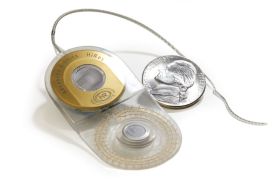

 Picnic with Ants