There are a few different surgeries that are performed as a treatment for Meniere’s, this post will focus only on the 2 that I have undergone. Getting Tubes in my ears, and Endolymphatic Sac Surgery.
Tubes – A Tympanostomy tube (sometimes called Pressure Equalization tube, a Ventilation tube, or a grommet) is inserted in the eardrum to maintain a tiny hole. This procedure is often used to help people with chronic ear infections, especially children. Since patients with Meniere’s normally have fully functional Eustation tubes placing “ventilation” tubes in the ear shouldn’t do anything. However, many doctors still try this, and many patients say that it helps.
I first had a tube put in my right ear in the doctor’s office. No anesthesia at all. I will never do that again. It was a horrible experience. This tube fell out within just a couple of months. I then had a T-tube put in, they are more permanent, often lasting years, and that was done under general anesthesia. This did seem to help my symptoms for a long time. When my symptoms returned we found out my tube had fallen out, at this time I was having trouble with both ears. So I had T-tubes put in both ears. The symptoms did not get better. At this time my old ENT told me he didn’t really know that much about Meniere’s. I immediately found a specialist. Dr. Kaylie, an otolaryngologist told me the reason I felt better could have been that I was just having a period of remission. He pointed out that my tube could have been out a long time before I started having the attacks again, and we simply didn’t check it until the attacks came back.
So did the tubes work for me…maybe, maybe not. I thought they did for a while. (over a year) But the symptoms came back, and the new tubes didn’t help. So I just don’t know.
Endolymphatic Sac Surgery – There are a few different Endolymphatic Sac Surgeries: Endolymphatic Shunt Surgery, Endolymphatic Sac Decompression, and Endolymphatic Enhancement Surgery. Often these terms are used interchangeably, but they can mean very different things.
Endolymphatic Shunt Surgery normally means that the surgeon puts in a tube to “shunt” the fluid from the endolymphatic sac to either the cranium or the mastoid cavity in the middle ear. Most people think that the tube is a “shunt”, but the definition of the word shunt is to move fluid from one area to another.
Often the term Enodymphatic Shunt Surgery is used for each of the endolymphatic surgeries, since the fluid is being “shunted” to a different area in each.
Endolymphatic Sac Decompression Surgery is a surgery in which the surgeon cuts a hole in the endolymphatic sac and drains it, but doesn’t put in a tube.
In Endolymphatic Enhancement Surgery the surgeon doesn’t normally drain the sac, he or she will enlarge the area around the endolymphatic sac so the sac will have more room to expand during an attack. Therefore, the fluid will have more room within the membranes and sac without causing it to leak or burst. This is the surgery that I had, however, my doctor often called it a “shunt” surgery.
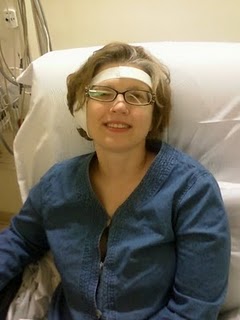
Dr. Kaylie put an incision around the back of my ear. He went in and removed part of my temporal bone and skull around the Endolymphatic Sac and Dura Mater. Now my membranes should have plenty of room to become dilated without harm.
We decided to do the right ear because it was the original ear affected, and it was causing most of my vertigo attacks. For months I had very little vertigo, and even when I started having attacks again they were being caused from my left ear. I think my hearing dropped in the right ear after the surgery, however, it has been stable since then. I will now be able to get a hearing aid for that ear since the fluctuations have stopped.
I was very pleased with the results from this surgery. It drastically reduced the number of attacks I was having in my right ear, and it stabilized the hearing in that ear. However, the recovery was difficult. I was in and out of the hospital the day of the surgery, but this is a very invasive surgery. It was painful for months. I think the pain would have been lessened if I didn’t have to wear glasses. My glasses would irritate the incision. I had to take the arm off of my glasses for a long time. I do however, want to stress that this was not an easy in and out surgery. At least it wasn’t for me. The recovery period was much longer than I thought it would be. (over a month) However, I’m not sorry that I did it, and I would do it again if necessary.
***update*** after a year, I ended up having the endolymphatic sac surgery in my left ear too. The vertigo was cut by about 75% for about a year and a half. Then it came back full force. I do not feel this surgery was worth it. If asked at this time, I would not have the surgery again. I’m glad I had less vertigo for about 2 years, but there is a possibility I may have had less anyway, and the surgeries were very difficult (for me) The first was very painful, the second caused severe vertigo for over a week.
I started having attacks again within 5 months of the surgery, but they were being caused from my left ear. It was causing attacks as often as 3-5 times a week. I went in to talk to Dr. Kaylie about having the surgery on my left ear, but he asked me if I would be interested in possibly finding the cause of my Meniere’s. Of course I was interested…
and that will bring us to my next post: Treatments for Meniere’s – Part 4 Stabilizing Abnormal CSF pressure.
I’m also happy to announce that I will be having a few Guest Posts coming up after my next post from fellow Meniere’s patients who will talk about the different treatments they have undergone.
To read more about different treatments, there is an intensive list at Meniere’s Info.com.
If you have any questions about the treatments I have undergone, please feel free to ask me about them, either in a comment or feel free to email me!











 Picnic with Ants