Guilty!

The fraudulent Gluten Free Baker, Paul Seelig, owner of Great Specialty Products, was found guilty of 23 counts of fraud, and sentenced to no less than 9 years in prison.

To read more about this please see my post on Wendy Cooks: Fraudulent Gluten Free Baker Sentenced.

Thank you all for supporting me through this.  I’m so glad this is over, and I put it behind me.  I used to buy gluten-free products from local bakers, trying to support our local businesses.  Now, that has been spoiled.  How can I trust people to really be baking gluten-free?  Until the FDA states the requirements for a business to say their products are gluten-free, I won’t be buying any products that aren’t certified gluten free.

I’m really driving again now!

I’m so very excited, we bought me a car yesterday!!

It’s been about 4 years, give or take, since I had a car of my own.  Now that I can drive again, and we will probably be having a child in the house soon, it was time for me to start looking at cars.  It has taken about 2 months of looking, but yesterday we found the perfect car!

It’s a 2008 Convertible Volkswagen Beetle.  Isn’t it cute??

As a friend of mine said today, “Watch out Wendy’s on the road again.”

What a milestone.  Just think, I couldn’t drive just a few months ago, now I have my own car.  hehehe!

Meniere’s Treatments, Guest Post – Lin

Lin, known in the blogosphere as LinLori, has a very interesting blog.  You can find her at linlori.com.  Lin is a mother of 2 toddlers, and wife to “MarvMan” who is currently active duty Navy.  This is her story of being diagnosed with Meniere’s and the treatments she has tried.
When Nothing WorksAs I write this post, my mind is swirling with all sorts of things. My kids are getting ready for me to start homeschooling them, we’re getting ready for a cross-country move, I’m trying to clean out my house of unnecessary stuff, we have to figure out how to get two vehicles from one end of the country to another with only one of us being fully able to drive 10-12 hours a day – and of course, that isn’t me.So I’m hoping that what I write makes sense, will help some, or will at least be something other Meniere’s friends can commiserate with. We have nothing if not each other.

My first attacks actually started while I was active duty Navy. I’d been crouched under a dark aircraft for a good couple hours working on an engine and when I came out into the bright hangar bay, I got dizzy. It was easily brushed off as, “A head rush. Clearly I was under there too long.” But they continued.

And of course, before seeking a doctor’s advice, I got pregnant. And so any complaints of dizziness were brushed off as, “Well, you’ve got double the amount of fluid in your body right now; of course you’re going to be dizzy.” So it continued and I thought it was just a bothersome thing I’d have to deal with because, clearly, my body was more sensitive to how much fluid was in it than most people.

It wasn’t until after my separation from the Navy (honorable, just early for parenting conflict reasons), and after our second child that my husband said, “You know, I think you should go have this checked out.” So I did.

The doctor said it was BPPV – benign paroxysmal positional vertigo, as we all know – and there wasn’t anything he could really do about it, except give me some exercises to do and tell me to come back if it got worse. Well. Thanks for that, doc.

And then we moved from Washington to Nevada. For a time, I ignored the “spells,” as I called them. What else was I to do? But,  of course – they got worse.

So it was back to the doctor with me. This time a new doctor, on a new base. He repeated many of the same in-office tests and checked my ears, cleaned them out, and gave me a referral to an ENT.

The ENT agreed with the BPPV diagnosis initially, and sent me for balance therapy. It helped a bit, and I enjoyed the sessions and the physical therapist I was working with.

Then I had a seizure.

Seizures are, of course, not usually related to Meniere’s, but migraines are related to Meniere’s and – to all our best knowledge after over a year and a half of research and trial & error – this seizure was migraine related.

Thus began the experimentation into how much effect, if any, food had on my Meniere’s. This is what we learned:

MSG has an insane effect on Meniere’s for me. If a food has MSG in it, within fifteen to thirty minutes of consuming the food, my heart rate will be doubled, I will be short of breath, experiencing hot/cold flashes, and – but of course – vertigo attacks that leave me bedridden.

The label “MSG” also happens to include High Fructose Corn Syrup. So you can imagine the rage I have at those, “It’s just like sugar!” commercials. No, it is not.

Of course, salt has an effect, from previous knowledge of how sensitive I am to fluid retention. So I’ve greatly decreased my salt intake.

In addition, I, the big coffee drinker, have had to seriously cut back on the caffeine intake. I usually only have a cup in the morning, and perhaps one in the afternoon or one in the evening. The interesting thing here is that I don’t feel as awful if I stick to grinding the beans myself and brewing it in a press-pot. I have yet to figure out the connection there.

What other treatments have we tried? Well.

Diuretic – The diuretic does seem to help, especially around my monthly cycle.

Steroids
My first ENT had me on so many steroids…

Oral Prednisone – This. One. Sucked. I felt nothing but the side effects. I was moody, always short-tempered, tired, loopy, and I gained seven pounds.

Ciprodex ear drops – This was after the ENT installed a tube in my ear drum in order to better administer the ear drops. I’ll cover the tube in a moment. The Ciprodex really didn’t seem to help all that much. My inner ear was incredibly sensitive to the temperature the drops were at, and it seemed to actually spark a vertigo episode rather than help any.

Steroid injections – I don’t remember the name of the steroids they injected through the tube, but these? Did nothing.

So when I got sick of my first ENT running up the insurance costs for steroid treatments, I found another ENT. This one now has me on

Triamterene – water pill, of course
Elavil – Anti-depressant, with surprisingly unexpected helpful effects for those with Meniere’s
Meclizine – Emergency anti-nausea anti-vertigo med for when I have an attack.

Unfortunately, as with the past few days, we’ve discovered that the Elavil – a second round after a 1 month break – is no longer working.

And, thus? The search continues. I’m only 26 – there’s time, right? 😉

Gardening, Fostering Classes, Housework, Hearing Aids…a busy week.

What a long title huh?

Boy am I busy this week.  Just think a couple of months ago I wouldn’t have thought about doing any of the things I’m doing lately.  (or planning to do…heck, I wouldn’t have made plans.)

So yesterday and today we started working in our little garden patch in the front of the house.  When it rains we have a river running through there so we had to be inventive.

Front Yard Garden, in progress.
Sandy walking through front garden.

I wish I had a before picture, then you would know just how much work we have done.  We decided to work with the water flow instead of against it.  We put some small pebbles to help the path of water, so it won’t tear up the garden, then sat potted herbs on top of the rocks.  (We still need 2 more pots to fill the area, but our local gardening center was out.)  The pots contain herbs, we have day lilies coming up from last year, and we put out wild flower seeds to fill in.  We’re also going to put a rock border around the front.  (We found a lot of cool rocks in the woods right behind our house!)

Tomorrow night we start fostering classes.  They will need to do a house visit to inspect where we live, so we need to get the house in order…and ready for a child.  We also need to sign up for CPR classes, including CPR for children.  And we each need to make appointments to bet a physical.  Lot’s to do, but totally worth it.

On Friday I’ll be getting my hearing aids.  How cool is that?  I just can’t wait to hear what I’ve been missing.  I wish I was getting them before we start our classes, I’m afraid I won’t be able to hear what’s going on.  Luckily, I’ll have Stuart there to help.

I’m still having too many headaches.  I do wish they would go away.  Perhaps the next time I see my neurologist she will be able to do more.  I’m also having more hip pain than usual, of course I’m doing more.  But that doesn’t mean I should be in pain all the time.

What is everyone else up to?

Thankful that I know…

When you are suffering for a long time and don’t know what’s wrong, when doctors look at you like it’s all in your head (and some even tell you that), when it takes years and still no one knows…it’s so nice to be diagnosed.

art by Aquatic Fishy at Deviant Art.com

Some of my illnesses were diagnosed fairly quickly, and still some things are still pretty vague. (chronic hip and pelvic pain – ummm, why?)

I know it may sound weird but I was so happy when I found out that I had a wheat allergy, gluten intolerance, hypothyroidism, Meniere’s, hypoglycemia, a B12 deficiency, a Vitamin D deficiency, and finally and most recently fructose intolerance.

Each of these diagnosis took a long time to discover.  Especially the wheat allergy (gluten intolerance) and Meniere’s.

For years I was sick.  I saw a note in my medical records one time from a doctor that said, “This patient comes in with a laundry list of complaints….”  I was shuffled from doctor to doctor.  I was told I had Fibromyalgia, chronic fatigue, and IBS.  I had to learn to live with it, and I did for years.  I even started a local Fibromyalgia support group.  (I’m so very thankful for one very special friend that came from that group.  You’re great Lisa!!)  But I never stopped looking for an answer, or something that could help.

Finally, I was reading about food allergies and asked my doctor to test me.  Come to find out I have a wheat allergy.  Thank Goodness, I found out.  I stopped eating wheat immediately, and started feeling so much better within weeks.  Then I read about how many people can not tolerate gluten, and the symptoms for celiac disease.  A lot of these symptoms fit me, so I decided to stop eating gluten, and it was like a light switch came on in my life.  I no longer felt like I had the flu all the time, or that I needed to sleep most of the time.  I had a new lease on life.  I’m so grateful.

I had vertigo attacks on and off for years, with a full feeling in my ear and a constant ringing, but no one could tell me why.  One night after having vertigo and throwing up over 8 hours my fiance (now my husband) took me to the emergency room.  The doctor there told me that he thought I may have something wrong with my ears.  Perhaps the crystals that some people get, or something else that causes vertigo…he even mentioned the possibility of Meniere’s.  I loved this doctor.  I was so grateful that he believed that there was something wrong with me, and I wasn’t just getting food poisoning over and over.  (yes, that’s what I had been told.)  So I went to an ENT, and he said I have Meniere’s Disease.  I was so thankful to know something.  Am I happy that I have Meniere’s? NO.  But I am just so thankful that I have a diagnosis.

I’m so happy to be involved in the research going on at Duke to find out if an imbalance of Cerebral Spinal Fluid (CSF) may be one of the causes for vestibular vertigo in some Meniere’s and Ramsey Hunt Syndrome patients.  I was so very happy to find out that I had CSF leaks and they could patch them. My life is a new again.  (no vertigo for over 2 months now!)

Most recently, after 7 months of chronic, almost daily, diarrhea; and a battery of tests, I am so thankful to find out that I have Dietary Fructose Intolerance (or Fructose Malabsorption).  Yes, it makes eating much more difficult, but I’m already feeling better after just one week.  What a difference knowing can make.

Am I thrilled to have so many chronic illnesses?  Of course not.  But I’m so thankful that I know.

I’m also thankful for all that I’ve learned from having chronic illnesses.  I’ve grown so much as a person.  But that story is for another day.

Thank you all for supporting me through all of time trials.  Isn’t it great to know?

Thank you! and What’s up with Wendy?

First I would like to thank all of my contributors to the Meniere’s Treatments Series.  I hope we all learned something (I know I did).  I’m also hoping that this series will help those who are going through all of this understand that they are not alone.  That not all treatments work for everyone, but there are many treatments out there and hopefully one will work for them.

Thank you to all who contributed, either through a guest post, or by commenting.  This could not have worked without all of you.

It’s been a while since I posted about what’s going on in my life.  So, on at the risk of boring you, here it is:

NOT Gluten Free!

The biggest thing that is consuming my mind today is the trial against Paul Seelig.  The man who is accused of selling bread as gluten free when in fact is wasn’t.   I have to testify against him on Thursday.  This is just so hard.  I don’t want to see this man again.  I don’t want to relive what he put me through.  I read a post on Facebook by a woman who was at the trial yesterday.  They were selecting the jury.  She said that he kept chuckling.  What could possibly be so dang funny?  She also said that many potential jurors said they couldn’t be impartial because what he did was so horrible.  Hmmm, what about innocent until proven guilty.  I mean I know he’s guilty because I was there, but if I wasn’t I don’t think I could say that.

Of course, that is what I said the whole time all of this was going on.  People were saying they were getting sick from the gluten free bread this man was selling, heck I was sick.  But there was only a few people, and I thought I was sick from Meniere’s.  I felt that people were publishing things on their blogs about his selling bread as gluten free before they really had any proof.  Plus, he kept telling me that he was setting up a time for me to come in to his bakery and be there when he had testing done, so I could witness it.  He even applied with the Gluten Intolerance Group to have his facility certified gluten free.  I kept thinking, why would he do this if his products were in fact not gluten free.

However, even if he was guilty (as I now know he is) I felt that it was irresponsible for people to be publishing this without proof.  And I didn’t feel like a home gluten test was enough.  After all, we wouldn’t know if it was cross contaminated or not.

But the sad fact is, I believed him. He told me that he sold to the government and to hospitals.  He said he only sold to the public because he wanted people to be able to have good gluten free bread.

I look back at the emails we wrote to each other and I feel so very stupid.  Why did I believe this guy?  I think I just couldn’t believe that anyone would purposefully contaminate people.  And how could he be so stupid that he didn’t think he would get caught?  He was making people sick, did he think they wouldn’t eventually put it together?  I fell so betrayed.  He must really have been thrilled to have had someone who was so gullible on his side.

Ok, enough about that.  I’ll let you know how it goes after I testify, and then after the trial is over.

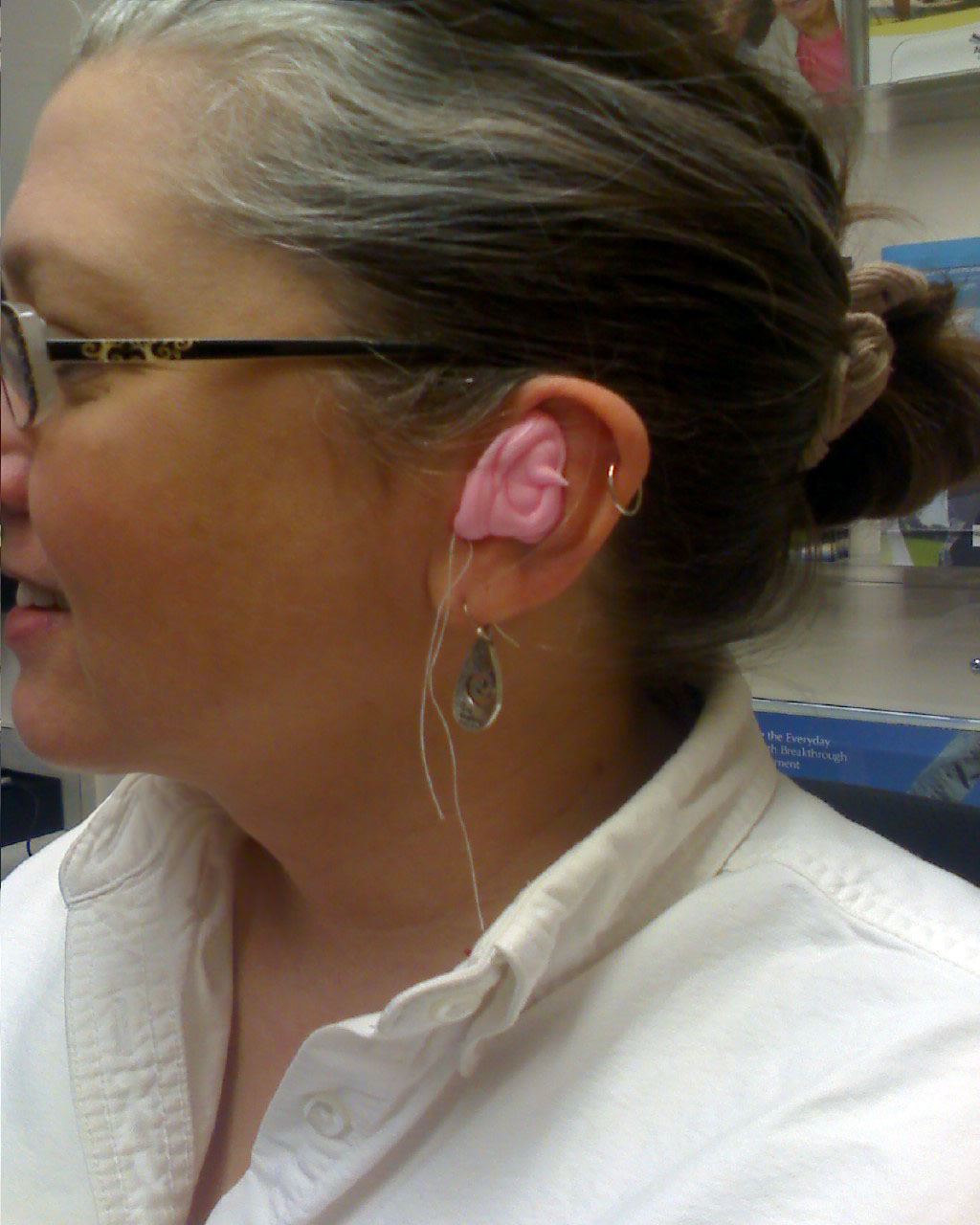
making a mold of my ear for my hearing aids

I have some good news.  I was fitted for hearing aids last week.  I will be getting them on the 8th.  I’m very excited.  Think of all the things I’ll be able to hear, that I can’t hear now.  hehehe.

The fructose intolerance diet is going well.  I saw the nutritionist on the 23rd.  She put me on a pretty strict fructose elimination diet for 4-6 weeks.  Then after my body starts absorbing nutrition again, I can try to add in new foods and see how I do.  Right now, I’m doing so much better.  No GI upset.  I did have a little of one thing on my NO list, and I got so bloated, and gassy.  Then within an hour I had a horrible migraine.  I’m really hoping that once I get this food intolerance under control I will stop having so many migraines.  (one can hope right?)  According to our scales, it looks like I’ve lost about 2 pounds this week.  Oh, I forgot to mention, the nutritionist told me I’m not eating enough.  I’ve been trying to eat more calories since I saw her, but it’s really hard for me.

I joined Spark People, an online weight loss community, so I could log everything I eat and keep up with my symptoms and my calories.  If you happen to be over there, look me up, my username is ONEARTSYCHICK.

One more piece of news.  Stuart and I are starting classes on April 5th, to become Foster Parents.  I may need a lot of advise from you who have children.  Wish us luck!

As you can probably tell, the patches are still holding, and I’m not having any vertigo, and the disequilibrium is gone.  Hearing is stable.

My hip is bothering me much more.  I’m sure it’s because I’ve been doing more.  But it’s a real pain….literally.  I’m also having more trouble with the pelvic pain, I’m sure that’s because I’ve been feeling a little more amorous lately, since the world stopped spinning.  However, just because I know why these things are bothering me more doesn’t mean it should be that way.  I should be able to walk and not hurt, or have sex without pain.  One thing at a time.  Perhaps I will get there.

What’s going on with you these days?

Meniere’s Treatments Guest Post – Susanna

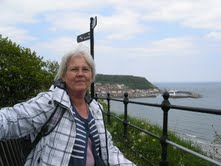
Susanna, on a trip to see her son in England May, 2010.

Today my guest is Susanna, a lovely woman from Linköping in the southern part of Sweden.  She is married and has three “almost grown up kids”.  She was working in the school system, but last year she went on permanent sick leave from work.

Susanna has had Menières for about ten years, bilateral for three years.

She stresses that “with the support from my family and relatives life is pretty good today!”

Coping with my Menières by Susanna Ahlström

I had my first bad vertigo attack the summer of 2002.  Before that I had tinnitus, fullness in my ear, and a few minor dizzy attacks.  But this time I was really ill and the ENT doctor told me this was Menières.  I was sent home with a diuretic and some pills for seasickness.  And of course I was told to keep a low sodium diet.  I felt better after a few months and started working again.  But I never got rid of the tinnitus or the imbalance and the anxiety I felt was limiting my whole life.  My boss saw how I felt and helped me to see a therapist.  I meant to see her about 10 times – we had our sessions for two years.

After about 5 years I felt so much better and I started full time at work.  My tinnitus didn’t bother meat all, I felt almost normal then I got a new chief at work.  Let’s say this became a hard time at workand my Menière started bothering me again, now with several attacks a week.  A period of trying different treatments started:

Betaserc, the Serc
I´ve taken the pills for many years now, increasing the dosage several times from 8 mg per day till today when I take 64 mg.  This medication is meant to increase the blood flowing in the small vesselsin the inner ear.  I’m not sure if it really helps, but I don’t dare to stop taking it.

Diuretic
I´ve been taking this for many years now on a low dosage.  I can take an extra pill the days before myperiod begins when the body feels a bit swollen.  And I keep on taking this medication, maybe it helps a bit.

SPC-flakes
I´ve been eating these oat flakes with my yoghurt every morning for many years.  You take 1 gram of the flakes for every kilo you weigh, every day.  The oatflakes have been processed in a special way, malted, and contains something called Anti Secretion Factor which helps the body’s fluid and secretion level to be stable.  It´s rather expensive but my doctor prescribes it for me.  My stomach has never been better!!

Tube
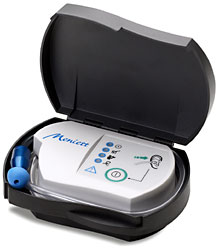
I had a tube put in through my eardrum in one ear while I was waiting for the Meniett.  I was able to borrow the Meniett from the hospital to see if this was something for me.  I felt less pressure in my ear while I had the tube, but this was about it.

Meniett
I tried the Meniette for one ear for some months.  I had so much hope before I started but this was nothing for me.

Carbamide/Urea
White crystals in a small plastic bag make me think about other things than medication but this is something you take with some water as soon as possible when a vertigo attack is coming.  It helps the fluid level in your ear (and of course in the entire body) to become lower.  It tastes really bad and almost made me throw up and it didn´t prevent the attack from coming.

Cortisone
When I got Menières in the other ear I took cortisone (prednisolone) on a very high dosage for a few days.  I will never take it again if I don’t have to. I got hyperactive, had a high pulse/heart beat, got a gastric catarrh so bad I fainted at work and ended up at the hospital.  And this treatment didn’t help me at all.

Cortisone injections
A rather new treatment here in Sweden is cortisone injections through the eardrum and into the middle ear.  If the tissue in the middle and inner ear is swollen the cortisone can help.  The injections are given 5 days in a row and you have to lie still on your side for about an hour.  Before the injection I had anesthesia ointment on the eardrum to make it numb.  This treatment was just a little painful, a quick pain while the doctor injected the cortisone.  I got it for both my ears with a few weeks passing between, and then we tried it once again on one ear.  I cannot say it helped much though.

Gentamicin
This is a treatment I didn’t really want to try so when my doctor recommended it I wanted to wait and think about it.  Then I became bilateral and gentamycin injection is no longer an option.  Neither is surgery.  I know they do the saccotomi shunt surgery sometimes but I’m told that many Patients who had the surgery are only helped for a short while.  When I had my worst period of illness I believe the doctors could have done what surgery or treatment they wanted if I only got rid of the vertigo!

This seems to be my story.  I’ve tried so many treatments without any success at all.  For every new treatment I’ve tried my hope has diminished.  But there are a few things I’ve tried which have made iteasier to cope with this illness:

Acupuncture
This has helped me to relax and even to take away the constant dizziness in my head.  Not for long only half an hour or so, but a very good half hour.

Chiropractic and massage
The constant dizziness makes my neck and shoulders stiff, and the stiffness in this part of the body seems to increase the dizziness.  A chiropractor has helped me to make my neck better.  A goodmassage has also helped.

Therapy/counseling/medication
First I met a counselor at the hospital who works with patients from the ENT department.  Later, I’ve seen a psychotherapist for two periods.  When I got ill again four years ago it really made me depressed.  Life was not worth living although suicide was not really an option.  The therapy has helped me to deal with being chronically ill, not being able to work, the guilt I felt of being a lousy mother and wife.  At the therapist I learned not to fight so hard against an illness you cannot win the battle with.  Now I try to walk along and follow the illness.  We haven’t “made friends” but Mr. Menière is not my enemy any more. He is more like the annoying neighbor you have to live beside.  I´ve also started medication to increase the serotonin level, with medicine also called anti depressive pills, on a low dosage.  It doesn’t make life a feast but it certainly makes it easier to deal with the hard issues in a better way than being over whelmed by the problems.

Life today is rather good. The illness has taken a lot from me but also given me something.  New experiences, new friends, new hobbies and I certainly have had to get to know myself!

**Please note that I (Wendy) have added links the treatments that Susanna tried.  The links will lead you to sites that I found giving definitions of the terms, or to studies about the treatment.

As always remember that different treatments work for different people.  We are not doctors and we aren’t telling anyone what they should do.  This series is to allow people with Meniere’s to see how others have dealt with this disease.

Meniere’s Treatments Guest Post – Deb

Deb from Faith Hope and Fighting Spirit is my Guest writer today.  Like many of us she suffered with Meniere’s for several years before she was diagnosed.  Deb is a teacher in Barrie, Ontario, Canada (1 hour north of Toronto).

This is the story of her trials with the treatments she has tried, and what is working for her.

The Meniett Device

Here is the readers digest story of my fight with Meniere’s. I have found the Meniett Device extremely helpful as a treatment, albeit, not a cure. I have tried various treatments over the years, but so far this treatment seems to work the best for me.

It is difficult to track exactly when Meniere’s first hit me but it was likely December 2001.

For 7 years I had attacks but I didn’t know what was wrong with me. Doctors thought they were vertigo migraines. It was not until 2008 that I was diagnosed with Meniere’s Disease and my Oto/ENT prescribed a low sodium diet and Serc. For over a year this helped but by the spring of 2010 I became very sick and began to miss work for weeks at a time. I am a teacher and in the fall of 2010 after a long hot summer I could not return to work. I couldn’t walk. I couldn’t even get dressed by myself or go to the washroom alone. I was desperate. I know I was depressed.

My Oto/ENT just kept giving me more and more Serc that wasn’t doing anything so I tried everything. At one point I was seeing my Oto/ENT, my family doctor, a chiropractor, a natural path, an acupuncturist, a massage therapist and an osteopath! I needed  a secretary to keep me straight with my appointments.

I was then given the opportunity through my Oto/ENT to be fitted with a ventilation tube so I could try a Meniett device. I had read about the device and wanted to try it, even though I wasn’t sure my insurance would cover the $3500.00 cost! This was on September 20th, I was not well enough to go back to school so what a Godsend this Meniett was! Miracles happen daily and I have been fortunate enough to be part of one. God heals in all sorts of ways and with me He chose the Meniett!

After using the machine just 5 days I was well enough to run again! I had missed this desperately. Three weeks after that on October 12th I was able to return to school. I was so happy to see my students and to lead a “normal” life. I hope I remember this feeling always. Illness really can be a blessing, especially when you can be so thankful for the healing in the end.

Since then I have used the machine 3-4 times a day. Each session takes about 5-7 minutes and it is small enough that I just carry it to work with me and use it on my lunch. My original tube was blocked recently but my Oto/ENT replaced it with a larger one that should last me 18 months. The procedure for getting the tube inserted takes about 5-10 minutes and is not that painful. My doctor just used a local anesthetic that burned a bit when it was put on but that’s it.

The premise behind how it works is that the air puts pressure into the inner ear which then moves the excess endolymphatic fluid to the endolymphatic sac.

You can check out more information on the Meniett and how it is used at:  http://www.meniett.com/

They will usually give you a 60 day trial period. If it doesn’t work for you, just send it back and they will not charge your credit card.

I am not entirely drug free. I still use meclizine periodically and I take Ativan at night if I am feeling extra stressed or I can feel the spins lurking in the back of my head. The really good news is that after a good fight with my insurance company it looks like they will finally pick up the cost!

I hope this helps. I wish all of you good health and strength to continue the good fight!

**Please note that I (Wendy) have added links the treatments that Deb tried.  The links will lead you to sites that I found explaining the premise behind these treatments, or to definitions of the terms.

As always remember that different treatments work for different people.  We are not doctors and we aren’t telling anyone what they should do.  This series is to allow people with Meniere’s to see how others have dealt with this disease.

To keep up with Deb’s progress please check out her blog Faith, Hope, and Fighting Spirit.

Next Post: Meniere’s Treatments Guest Post – Susanna

Meniere’s Treatments Guest Post – Angelea

Angelea is a fellow Meniere’s Warrior and Blogger.  Visit her blog at A Day In The Life With Meniere’s to keep up with her story.

Angelea lives in San Diego, California and is a wife, mother of three, and works as a nutrition support dietitian for a home infusion company.

This is her story:

When you are miserable and living in fear of leaving your home because of recurrent vertigo, you will try almost anything to feel better and get your life back.  From the day I was first diagnosed with Meniere’s disease, this is how I have felt.  Initially, I was confident I would respond to “conservative medical management.”  The odds were in my favor if you believe the statistics that 80% of people with MM (Meniere’s) do, in fact, manage pretty well on diuretics and a low-sodium diet that includes little to no caffeine or alcohol.  Even though salt, caffeine, and alcohol in the form of a glass of red wine with dinner were the cornerstones of my otherwise healthy diet, I was up for the challenge.  Bring it on! 

Unfortunately, despite a complete overhaul in my diet that resulted in an almost ten pound weight loss, vertigo episodes lasting 8 to 12 hours continued to plague me anywhere from two to four times weekly.  During this time, my dedicated husband scoured the internet and came up with some alternative treatments for me to try.

The first alternative to my doctor’s first line of defense (diuretics and diet) was to try antivirals.  There are a few published studies on relatively large populations of MM sufferers that suggest a strong correlation between the herpes class of viruses and MM and a significant improvement in symptoms with antivirals.  My doctor was familiar with these studies, however he is not convinced of a link just yet.  Regardless, antivirals being a relatively safe class of drugs, he was agreeable to prescribe a short course of Acyclovir.  I started off following the American (Gacek, et al) study’s protocol of 800 mg 4 times a day for 3 weeks.  By the end of the first week, my symptoms seemed to greatly improve.  But the vertigo returned with a vengeance once I began tapering to 3 times a day.  At that point, I asked to increase to 5 times a day consistent with the common dosage given for other herpes infections.   Again I improved over the course of the next 2 weeks.  But my prescription ran out and my doctor was not comfortable allowing me to continue on the high doses indefinitely.  Honestly, I didn’t want to be dependent on taking pills for who knows how long and continue to live in fear every time I tried to taper to a maintenance dose.  I just wanted this nightmare to end.

The next alternative treatment was a supplement regimen promoted by a guy on-line who calls himself John of Ohio.  Apparently a retired biology teacher, he did some of his own research and claims to have gained control of his own MM symptoms by taking a plethora of dietary supplements.  His logic was, well, logical so it seemed to be worth a try. It turned out not to be for me.   First of all, I was popping pills all day.  A couple had to be taken on an empty stomach, a couple more with food.  Some were familiar vitamin supplements and others were obscure to the point that they could only be found from a small handful of on-line suppliers.  Nonetheless, I stuck with it for a couple of months.  Some followers claimed relief almost immediately, yet others didn’t notice results for months.  It all sounded really good in theory; however, I have my reservations about the supplement industry, as well as the purity and long-term safety of their products.  Time and again, private testing companies have proven that many supplements are contaminated with potentially dangerous ingredients and/or contain significantly more or less of the active ingredient than what is stated on the label.  Then there are the studies that found that Beta Carotene supplementation, for example, promotes lung cancer cell growth and folate supplementation is linked to an increased incidence of colon cancer.  Finally, if one is taking a bioactive agent in high enough doses to have a therapeutic effect on the inner ear where blood supply is low, imagine the potential effects, good or bad, on the tissues in the rest of the body.

The way I saw it at this point was that it was only my ear that had a problem, so why not localize my treatment approach?
But, at the encouragement of my husband after having had read some pretty convincing testimonials on-line, I had to exhaust one more alternative treatment: upper cervical chiropractic adjustments, aka NUCCA.  The theory here goes that the nerves between your cervical vertebrae can become compressed and this can contribute to everything from MM to MS.  Again, logically, it could be possible, especially since this is the segment of the spinal cord innervating one’s ears and eyes, among other things.  Of course there were only two NUCCA chiros in my area and neither was covered by my insurance even though I have chiropractic coverage.  So out came a boatload of money for a 3-month course of adjustments and, somewhat worrisome, x-rays.  Yes, my posture improved a bit, I think, and it was completely painless to the point that it was hard to really believe this guy was doing anything at all except laying of hands on my neck.  A nice enough (young) guy, but as I got to know him over the weeks I found him to be quite naïve and really just not very smart.  I would say it was a relatively harmless thing to have tried except for the exposure to all the unnecessary radiation and the huge hit to our credit card.  And I continued to have vertigo as bad as ever.

By this time, I was 7 months into this nightmare and I just wanted to wake up!  Back to the doctor I went and it was decided the next best course to try was intratympanic dexamethasone injections.  I got one in October with some improvement and another in November.  I made it through December and January vertigo-free and finally feeling like a normal person again.  Then the week before my son’s 9th birthday, wham!  The nightmare returned.  I went in for another series of dex injections, as well as a trial of another diuretic (hydrochlorothiazide to Neptazane and back to HCTZ).  The dex failed miserably and I developed an allergic reaction to the new diuretic.  At this point, my doctor suggested adding high doses of oral steroids to another intratympanic dex shot.  Having worked with patients on oral steroids, I was all too familiar with the nasty side effects of these potentially dangerous drugs.  Plus, I was devastated to have experienced such a wonderful period of remission followed by complete failure and misery.  I was done.  I wanted off this rollercoaster.  I wanted to move on to something that had the hope of offering permanent, or at least long-term, relief.

I had been reading about intratympanic gentamicin treatments for months by now and this treatment strategy seemed to offer the best of both worlds: it was noninvasive and potentially permanent.  I had no fear.  My life was severely limited by now and I had nothing to lose.  So on March 25th, 2010, I had my first gentamicin injection.  It was a nonevent, painless as the dex had been.  I went home and waited.  I had a couple more vertigo attacks, but about 10 days later I began feeling the telltale signs that something was happening.  My balance was very poor and I felt really weird, but the vertigo and nausea were gone!  I would say it took about 3 months to regain a pretty decent sense of balance and another month or two for my hearing to improve a bit to a new baseline.  I still felt the episodic pressure in my ear, as well as fluctuating tinnitus just as I had before with my vertigo attacks, but I could function and life went on.  I continued to work, run the kids around town, and no longer lived in fear.

My doctor was surprised I had responded after just one gent shot.  He gives a lot of them and said the average number of shots patients needed before they got relief was 2.something.  I had read, and he concurred, that the vertigo could return, usually within the first year.  And sure enough, it did.  I got 8 beautiful months of relief and then my world turned upside down once again in November, 2010.  While it was disappointing, I was not defeated.  I knew what worked and went back to the doctor for another shot two days later. Then I waited and waited and waited.  Six weeks later, I was again confined to my house and suffering long episodes of vertigo several times weekly.   This had to be one of my lowest points.  The what-ifs reared their ugly heads and I had to seriously consider surgery.  I got a second opinion at the House Ear Clinic, even though my own doctor is a world-renowned specialist in treating MM.   They had nothing particularly new or better to offer me.

At my follow-up appointment with my regular neurotologist on December 30th, I was prepared to sign on the dotted line to have surgery: either endolymphatic shunt surgery or the more invasive, but more promising, vestibular nerve section (VNS).  But my doctor was agreeable to try one more gent shot, even though my hearing had diminished quite a bit over time.  The risk of too much gent being deafness.  But this, to me, was preferable to the possibility of a failed sac surgery or to anyone poking around behind the protective barrier of my skull.

This time I waited 3 long weeks and then, success!  I have been vertigo-free since the 3rd week of January.  I still feel off-balance and have lots of little mini-spins lasting a second or two several, several times a day.  I still want to complain many days, but I can’t.  I am vertigo-free!  Hallelujah!
I don’t know what the future holds, but I am just grateful for today.

Be sure to follow Angelea’s progress on her blog A Day In The Life With Meniere’s.

Treatments for Meniere’s Part 4 – CSF adjustment

If you’ve been following my blog you probably already know much of what I’m going to say here.  If you haven’t been following my blog, you can read even more about my experience with this treatment over the last few months.

In November of 2009, I started seeing Dr. Kaylie at Duke University Hospital’s Vestibular Clinic.  “Physicians at the clinic conduct clinical research to learn more about vestibular function in people who suffer from balance disorders such as Ménière’s disease, migraine-associated vertigo, and viral inner ear diseases. Several studies are ongoing that will provide insight to help improve therapies.”  They are also “conducting research into chronic, disabling disequilibrium after Ramsay-Hunt syndrome and Ménière’s disease.”

In October of 2010, I went to see Dr. Kaylie about possibly getting the Endolymphatic Surgery in my left ear to try to control the vertigo I was experiencing.  At this time he asked me if I’d rather have the surgery, or try to find the cause of my Ménière’s.  Of course, I chose to try to find a cause.

Dr. David Kaylie and another doctor at Duke, Dr. Linda Gray Leithe, are doing research trying to find a cause of Ménière’s.  Dr. Gray is a neuro-radiologist, she is researching how increased or decreased spinal fluid pressure can cause different disorders, including Ménière’s Disease.

On November 3, 2010 Dr. Gray performed a lumbar puncture on me.  Before the procedure she told me that the normal rage for Cerebrospinal Fluid (CSF) Pressure was between 10 and 20.  I measured exactly in the middle, 15.  However, Dr. Gray doesn’t think that everyone should have the same “normal” baseline.  She does empirical testing to find out if her patient may indeed have low or high pressure even though they have “normal” readings.  First she added some artificial CSF and all of a sudden I was able to hear her talking behind me, when I couldn’t just seconds before.  My dizziness disappeared, and I felt great.  I was so excited.  (If this hadn’t worked she would have given me a medication to lower my pressure to see if it helped, but this wasn’t necessary.)

That night, I had a horrible vertigo attack.  It lasted for hours.  After talking with Dr. Gray she felt that the fluid she had added was leaking out and that caused me to have the attack.

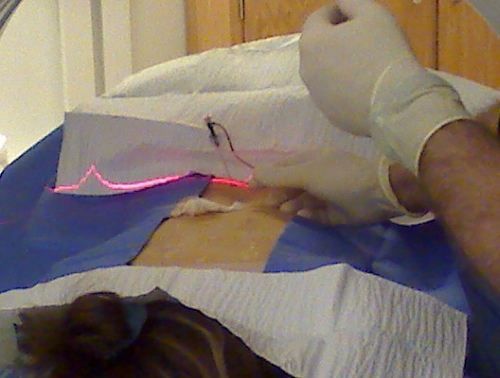
Photo taken my the Blood Patches.

On November 24th, she did another lumbar puncture, I was at 17.5.  She then performed a Myelogram.  During the myelogram Dr. Gray inserted a contrast dye in my spine, I then had to roll over and over and lift my butt in the air…to make sure the contrast dye was distributed evenly.  I was then given a CT scan that showed I had 6 leaks.  She then patched 4 of leaks that they found.  She didn’t patch them all because it could have caused my pressure to get too high.  She used my own blood to patch the leaks.  Immediately after the patches I could shake my head and not get dizzy.  I felt so much better…I felt normal.   (to see more photos and read more about this procedure see my post from Nov. 27, 2010)

Unfortunately, just 10 days after the blood patches, I started to have symptoms again.  Dr. Gray wasn’t sure if I had low pressure again or if I was starting to have high pressure.  So I took some of the medication that lowers your pressure.  I didn’t feel better, if anything I felt worse.  It took much longer to schedule my next lumbar puncture and patches because of the Holidays.  I had a very hard time during this wait.  I felt I had been abandoned.  The depression that consumed me was horrible.  Finally, I started to take the advice of my therapist and other Ménière’s friends, I decided to accept my disease.  I believe the Ménière’s will always be with me.  I don’t think I’ll ever be happy with this disease, but I accept that it is a part of me.  Even when I’m feeling good, I know it may come back.  This has really helped me to overcome my depression.

On January 28th 2011, Dr. Gray did another lumbar puncture and patched my leaks with something called Tisseel, a tissue glue.  Since she didn’t use the blood patches I didn’t have any extra fluid added during this patch.  It took me about 2 weeks to start feeling a lot better.  (To read more about this procedure please see my post from Jan. 28, 2011.)

I am now feeling so much better!  NO vertigo!  My hearing in my left ear is staying up and stable, my right ear’s hearing didn’t come back, and I still have tinnitus.  They think my right ear was probably just too damaged after having so many attacks.  I can deal with the symptoms I have left.  I’m leading a much more “normal” life.

Since the hearing in my right ear has stabilized, next week I will be evaluated for hearing aids.  I’ll let you know how that goes.

I’ve been asked a few questions about this procedure, I thought I’d try to answer some of them here.

  1. What caused the leaks? I don’t know.  It could have been caused by an accident, or it could be simply genetics.  Unless CSF leaks are found right after an accident, they rarely figure out what causes them.  It’s funny, until someone asked me, I didn’t even think to ask.  I was just so happy they found something tangible that could be causing my symptoms.
  2. Do my doctors think this could have been the cause of the Unilateral Ménière’s or was it something that happened later on? It’s my understanding that they are thinking this would have been the cause all along.  I know they are not just testing this on bilateral patients but also on unilateral Ménière’s patients as well.  Only one person they tested ended up not being helped by this at all.
  3. What’s next? Well, I have the evaluation to possibly get hearing aids next week.  But I don’t see Dr. Kaylie again for 6 months.  Unless something happens, then I’ll see him and/or Dr. Gray before then.  However, they feel that they know what is causing my symptoms now, and if I have a relapse they know what to do to fix it.  (Yes, I could get another leak at some point in the future.)
  4. What about people who have high pressure how do they treat them? I’ve met another of Dr. Kaylie and Dr. Gray’s patients.  She has Ramsey Hunt Syndrome and was the first person brought into this research.  She wasn’t responding to normal treatments, so they decided to try this.  She has high pressure.  She was put on medication to lower her pressure.  It worked for a few months, but it hasn’t been able to control her symptoms.  Recently, Dr. Gray gave her another lumbar puncture and lowered her pressure.  She is now on more medication.  However, she may have to have a little tube (called a shunt) put in so she can drain the excess fluid when necessary.  They only do this if a patient’s pressure is very high and they can’t control it.
  5. How can I find out more information about this procedure? Feel free to ask me anything about my experience.  Also,  Dr. Kaylie and Dr. Gray, don’t mind answering questions.  Just click on their names and it will take you to their pages on the Duke site, where you can get information to get in touch with them.  If you need to email them, just write to me and ask me their email addresses.

I’m sure I’m forgetting something, so if you have any questions, please feel free to ask.

Up Next:  Treatments for Ménière’s – Angelea’s Story

As always remember that different treatments work for different people.  I am not a doctor and I’m not suggesting to anyone that they should try this or any other treatment I’ve tried.  This series is only meant to allow people with Meniere’s to see how others have dealt with this disease.